 Knowledge Center
Technical Sharing
Die Cut Incomplete or Through Liner
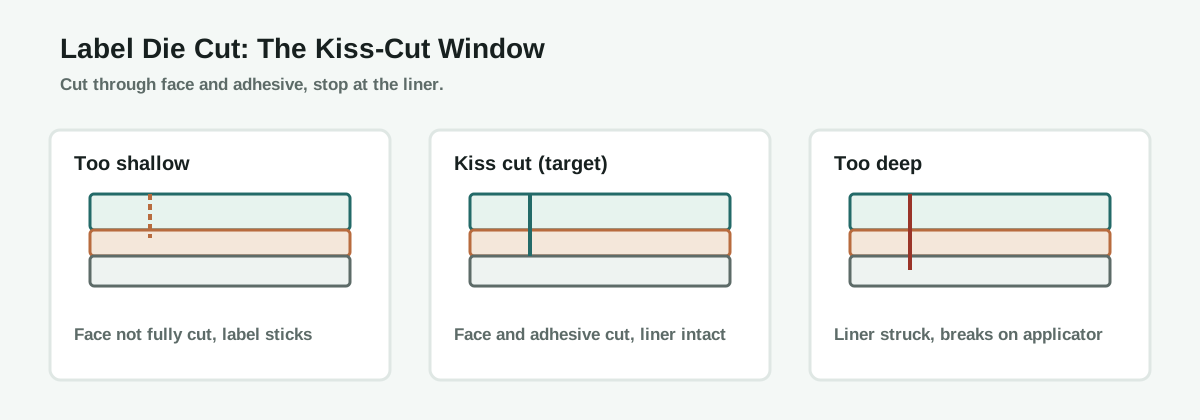
Label die cutting must cut through the face and adhesive but stop cleanly at the liner, a kiss-cut balance that fails in two opposite ways.
Quick Answer
A label die cut is a kiss cut: it must go through the face material and adhesive but stop at the release liner. If pressure or die condition is wrong, the cut is either incomplete, so labels do not separate, or it cuts into the liner, damaging it and causing breaks on the applicator. The fix is matching die pressure and sharpness to the face thickness, adhesive and liner.
The Problem
Two opposite failures share one root cause. An incomplete cut leaves labels that cannot be peeled cleanly, while a cut through the liner leaves a weakened or perforated liner that snaps during waste stripping, rewinding or automatic application. Both show up as matrix breaks, label tearing or applicator jams.
Material Analysis
- Face material: paper and film have different cutting resistance; film often needs more pressure but also tears more easily.
- Adhesive layer: adhesive cushions the cut and flows under pressure, so soft adhesives behave differently from firm ones.
- Liner: the liner is the safety floor of the kiss cut; its thickness and strength set the safe pressure window.
- Material stack tolerance: thickness variation across the web shifts the kiss-cut point.
Root-Cause Principle
The kiss-cut balance
Die cutting presses the die against the material stack. The die must penetrate the face and adhesive but stop before the liner. The safe window is set by the liner strength: the cut depth must be deep enough to separate the label but shallow enough to leave the liner intact.
A dull die, uneven pressure, a worn anvil or a changed material stack shifts this balance. When the die no longer cuts cleanly at the target depth, operators often raise pressure to compensate, which then cuts into the liner and creates die strikes.
How to Diagnose
- Peel a sample: an incomplete cut shows fibers or film still holding the label.
- Hold the liner to light: cut lines in the liner mean the die is striking too deep.
- Check die sharpness and anvil condition before raising pressure.
- Confirm the face, adhesive and liner are the same stack as the last good run.
Kiss-Cut Principle Diagram
Solutions
Never raise pressure to fix an incomplete cut without first checking the die. Compensation for a dull die is the most common path to liner damage.
Prevention Checklist
- Inspect and re-sharpen dies on a schedule
- Confirm liner condition on first samples
- Record pressure settings per material stack
- Check anvil and cylinder runout regularly
- Test a new material batch before a full run
FAQ
What is a kiss cut?
A kiss cut goes through the face material and adhesive but stops at the release liner, so the label separates while the liner stays intact.
Why does cutting into the liner matter?
A struck liner is weakened and can snap during waste stripping, rewinding or application, stopping the line and wasting labels.
Should I raise pressure to fix an incomplete cut?
First check the die sharpness and anvil. Raising pressure to compensate for a dull die usually leads to liner damage.
Does material thickness change the kiss cut?
Yes. Face, adhesive and liner thickness set the cut depth, so a changed material stack shifts the kiss-cut point.
What information should I send before asking for help?
Send the face, adhesive and liner, the die condition, the pressure setting and whether the defect is incomplete cut or liner strike.
Ask an Engineer
Struggling with incomplete die cuts or liner damage?
Send us your face, adhesive and liner, die condition and pressure setting. MWELLPACK can help you find the correct kiss-cut window.
Related Articles
Related Machines
Rotary Die Cutting Machine
High-speed roll-to-roll die cutting where kiss-cut pressure matters.
View machine guideFlatbed Die Cutting Machine
Die cutting with high cutting pressure for thicker and specialty materials.
View machine guideDigital Label Finishing Machine
Finishing with die cutting, matrix removal, slitting and rewinding.
View machine guide