 Knowledge Center
Troubleshooting
Label Static Electricity Problems
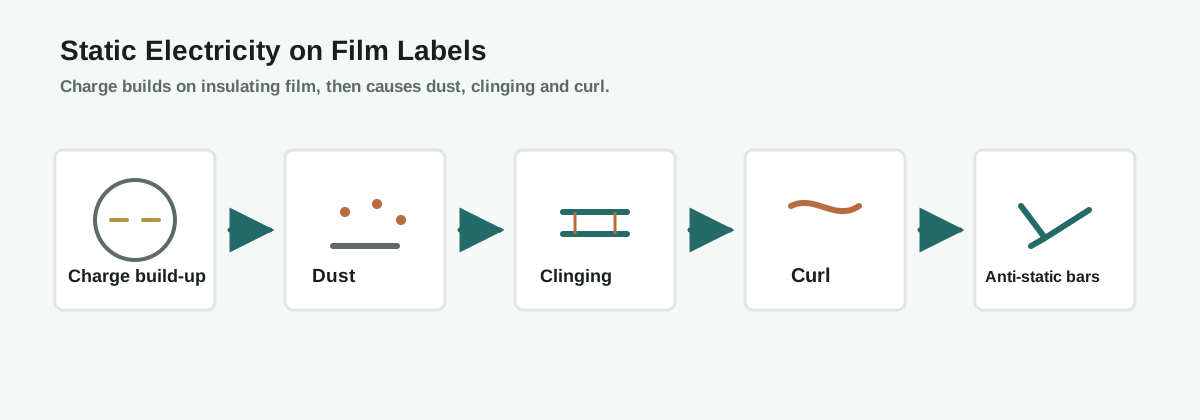
Static charge attracts dust, makes labels cling and mis-feed, and causes curl, and it is worst on fast-moving film webs.
Quick Answer
Static electricity builds up when a film web rubs against rollers, especially at high speed and low humidity. The charge attracts dust to the label, makes labels cling together and mis-feed, and can make the web curl or drift. The fix is to reduce static generation and add controlled discharge, usually with anti-static bars and humidity control.
Film labels build static far more than paper because film is a good insulator. Static is often worse in winter when indoor humidity drops.
The Problem
Static charge shows up as dust particles stuck to the label, labels clinging to each other so the applicator picks doubles, a web that wanders or curls, and sometimes a visible spark or shock. Each of these can stop the line or produce rejected labels.
Material Analysis
- Film is insulating: PP, PET and PE hold charge instead of letting it flow away.
- Low humidity: dry air lets charge build up more, so static is worse in winter.
- High speed: faster webs rub rollers more and generate more charge.
- Roller materials: some roller surfaces generate more charge than others.
Root-Cause Principle
Static charge is generated by friction as the web passes over rollers. On a conductive material the charge leaks away, but on an insulating film it stays and accumulates. The charged web then attracts airborne dust, sticks to itself, and repels or pulls against rollers, which causes mis-feed and curl.
The solution works from both sides: reduce generation by keeping the web path smooth and clean, and add discharge so any remaining charge is neutralized before it causes problems.
How to Diagnose
- Check indoor humidity: static is usually worse below about 40 percent relative humidity.
- Note whether the defect is dust, clinging or curl, because each points to where the charge is.
- Observe the web path for points where the film rubs rollers tightly.
- Compare behavior on film versus paper to confirm static is the cause.
Static Electricity Mechanism
Solutions
Anti-static bars reduce the symptom, but the best fix is removing the cause: a clean, smooth web path and controlled humidity.
Prevention Checklist
- Control indoor humidity, especially in winter
- Install anti-static bars near the unwind and before rewinding
- Keep rollers clean and check for worn surfaces
- Ground the machine and rollers properly
- Run at the fastest speed that keeps static controlled
FAQ
Why does static attract dust to labels?
A charged film web attracts airborne dust particles, which then stick to the label and cause print or application defects.
Why is static worse in winter?
Indoor humidity is lower in winter, and dry air lets charge build up more easily on insulating film.
Do anti-static bars remove static completely?
They neutralize charge but do not remove the cause. Combine them with a clean web path and controlled humidity.
Why do film labels build static more than paper?
Film is an insulator that holds charge, while paper allows charge to leak away more easily.
What information should I send before asking for help?
Send the material, web width, speed, humidity and whether the defect is dust, clinging or curl.
Ask an Engineer
Still fighting static on your label line?
Send us your material, web width, speed and humidity. MWELLPACK can help you control static and keep labels clean.
Related Articles
Related Machines
Inspection Slitter Rewinder
Slits and rewinds film labels where static must be controlled.
View machine guideDigital Label Finishing Machine
Finishes film labels with die cutting, slitting and rewinding.
View machine guideFlexo Printing Machine
Prints film labels where static affects print and feed.
View machine guide